Method MR305 NV: Why 17- and 18-Inch Truck Wheels Still Make Sense
The Method MR305 NV combines classic off-road styling, strong load ratings, practical 17- and 18-inch sizing, and multiple offsets for trucks and Jeeps. Here’s how Street-Loc styling, wheel diameter, width, offset, load capacity, and tire sidewall affect the finished setup.
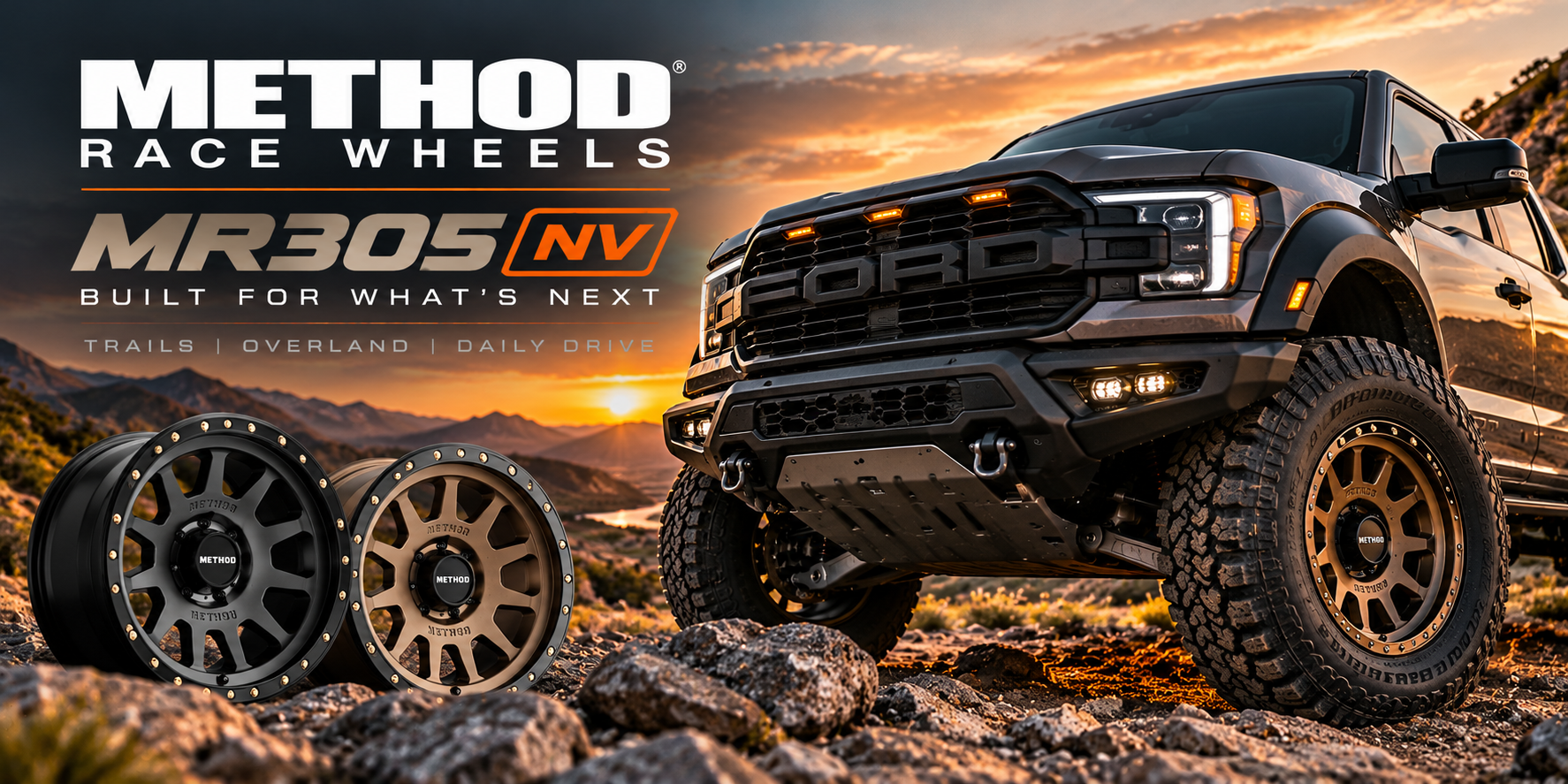
Truck wheels have been getting larger for years.
Twenty-inch wheels are common from the factory. Twenty-twos are no longer unusual. And aftermarket builds can go considerably larger.
But bigger does not automatically mean better.
For trucks and Jeeps that actually spend time on rough roads, trails, snow, gravel, or broken pavement, a 17- or 18-inch wheel can provide something an oversized wheel cannot: more tire sidewall.
The Method Wheels MR305 NV is a perfect example.
It combines Method's recognizable off-road styling with practical sizing, strong load ratings, and fitments ranging from five-lug Jeep applications to heavy-duty eight-lug trucks.
More importantly, the MR305 shows why wheel diameter should be chosen around how the vehicle is used instead of simply choosing the largest wheel that fits.
What Is the Method MR305 NV?
The MR305 NV is a one-piece cast aluminum wheel from Method Race Wheels.
Its design uses twelve windows around the face, a simulated beadlock-style outer lip, replaceable lip bolts, and a push-through Method center cap.
Method manufactures the wheel from A356 aluminum with T6 heat treatment.
The result is an off-road-oriented wheel available across multiple diameters, widths, bolt patterns, offsets, and load capacities.
You can compare current configurations through the Method Wheels collection at Elite Wheels.
Classic 12-Window Design
The twelve-window face is one of the reasons the MR305 remains immediately recognizable.
Rather than using thin street-style spokes, the wheel has a solid, mechanical appearance that works naturally with large all-terrain or mud-terrain tires.
It also leaves enough open area around the face to keep the wheel from looking visually heavy.
Street-Loc Lip
The MR305 uses Method's Street-Loc outer lip.
The undercut and replaceable lip bolts create the appearance of a traditional beadlock wheel without making the standard MR305 a functional beadlock.
That distinction is important.
The standard MR305 NV is intended as a conventional street wheel with beadlock-inspired styling—not as a wheel that mechanically clamps the tire bead between a wheel and external beadlock ring.
Why Are 17-Inch Truck Wheels Still Popular?
A 17-inch wheel leaves more room for tire sidewall than a larger wheel when overall tire diameter remains similar.
That can provide real advantages on a truck or Jeep.
More Tire Between the Wheel and the Ground
Imagine two vehicles both running approximately 35-inch tires.
One uses a 17-inch wheel. The other uses a 22-inch wheel.
The 17-inch setup has substantially more rubber between the wheel rim and the road.
That additional sidewall can help absorb:
- Pothole impacts
- Rocks
- Washboards
- Trail obstacles
- Sharp road transitions
Better Ability to Air Down
Off-road drivers often reduce tire pressure to improve traction and allow the tire to conform more effectively to terrain.
A taller sidewall gives the tire more room to deform when pressure is reduced.
This can increase the contact patch on sand, rocks, dirt, and other loose surfaces.
More Wheel Protection
More sidewall also places additional material between the wheel edge and an obstacle.
That does not make the wheel immune to damage, but it can reduce how easily a rock or pothole reaches the rim itself.
When Does an 18-Inch Wheel Make More Sense?
Eighteen inches can be an excellent compromise on a newer truck.
You still retain meaningful tire sidewall with a large truck tire, but gain additional clearance for brake packages that may not work with smaller wheels.
Modern Brake Clearance
New trucks increasingly use large brake rotors and calipers.
That can prevent certain 16- or 17-inch wheel designs from clearing the brakes even if the bolt pattern is correct.
An 18-inch wheel provides additional internal space.
Street and Trail Balance
An 18-inch wheel can also provide a slightly more modern visual appearance while avoiding the thin-sidewall look of very large truck wheels.
For a truck used both on pavement and off-road, this is often a useful middle ground.
What Does 17x8.5 Mean?
One MR305 configuration currently available through Elite Wheels is the Method MR305 NV 17x8.5 with 5x5 bolt pattern and 0mm offset.
The dimensions tell you several things about the wheel.
17-Inch Diameter
The first number tells you the wheel fits a 17-inch tire.
8.5-Inch Width
The second number describes the nominal wheel width between the bead seats.
An 8.5-inch truck wheel works with a broad range of all-terrain and mud-terrain tire sizes, but the specific tire still needs to list that wheel width within its approved range.
0mm Offset
A zero-offset wheel has its mounting surface positioned approximately along the wheel's centerline.
That does not mean the wheel will automatically sit flush with a particular Jeep or truck.
Vehicle hub position, wheel width, suspension geometry, and tire width all determine the final stance.
What Does 18x9 -12 Mean?
Elite Wheels also carries an 18x9 MR305 NV with a -12mm offset and 6x5.5 bolt pattern.
This configuration is both larger and wider than the 17x8.5 example.
9-Inch Width
Moving to a 9-inch-wide wheel changes the position of both the inner and outer wheel edges compared with an 8.5-inch wheel.
The additional width needs to be considered when calculating suspension and fender clearance.
Negative Offset
A -12mm offset moves the mounting pad farther toward the inside of the wheel relative to the centerline.
For a given wheel width, that generally positions more of the wheel outward compared with a more positive offset.
But offset should never be interpreted without comparing it to the original wheel and specific vehicle.
Why Offset Matters So Much on Trucks
Wheel offset affects far more than appearance.
Changing where the wheel sits also changes the position of the tire relative to steering, suspension, and body components.
Too Far Inward
A tire positioned too far inward may contact:
- Upper control arms
- Struts
- Shocks
- Sway bars
- Inner wheel liners
Too Far Outward
Moving the wheel outward can increase clearance around suspension parts, but may create new problems around:
- Fenders
- Bumpers
- Mud flaps
- Body mounts
- Wheel-well liners
The tire also travels through an arc as the wheels steer, which means clearance needs to be evaluated at full lock—not only while the truck is parked with the wheels straight.
What Does the MR305 Look Like With 0 Offset?
A zero-offset MR305 can create a more aggressive stance than many factory wheels, but the result depends heavily on the vehicle.
For example, the Method MR305 NV 17x8.5 0mm 8x170 uses the same basic width and offset concept as the 5x5 version while being intended for a completely different hub and vehicle class.
The 8x170 version has a 130.81mm center bore and is listed by Elite Wheels at approximately 35.6 pounds.
The visually similar 5x5 version uses a 94mm center bore and is listed at approximately 34.3 pounds.
This illustrates an important point: two MR305 wheels may look almost identical but still be completely different products mechanically.
Why Does Bolt Pattern Matter?
Bolt pattern is one of the first compatibility checks for any wheel.
The MR305 is offered in numerous patterns because trucks and Jeeps use many different hubs.
5x5
5x5, also written as 5x127mm, appears on several Jeep applications.
But matching 5x5 alone does not guarantee correct fitment.
6x5.5
6x5.5, equivalent to 6x139.7mm, is common across many Toyota, Chevrolet, GMC, Nissan, and other truck applications.
Again, the complete wheel specification still matters.
8x170
8x170 is used on several Ford heavy-duty truck applications.
An eight-lug wheel like the MR305 8x170 version is designed around a very different hub and load environment than a five-lug Jeep wheel.
What Is Center Bore?
The center bore is the large opening at the center of the wheel.
It must physically fit over the vehicle hub.
Same Wheel Design, Different Center Bores
The MR305 examples show this clearly:
- 5x5 version: 94mm center bore
- 6x5.5 version: 108mm center bore
- 8x170 version: 130.81mm center bore
This is why shopping for wheels based only on diameter and bolt pattern is risky.
The center bore, offset, load rating, brake clearance, and tire fitment all have to work with the vehicle.
How Strong Is the Method MR305?
Method lists standard MR305 applications with load ratings ranging from approximately 2,500 to 3,640 pounds per wheel, depending on the specific configuration.
Heavy-duty MR305 applications can reach a 4,500-pound load rating.
That range exists because the wheel family covers everything from Jeeps and midsize trucks to heavy-duty pickups.
Load Rating Is Per Wheel
Wheel load rating describes how much load an individual wheel is designed to support under its specified conditions.
You should not choose a wheel simply because its bolt pattern matches the vehicle.
The wheel also needs sufficient load capacity for the truck.
Vehicle Weight Is Only the Starting Point
A truck may carry far more weight in real-world use than it does in an empty factory specification.
Consider permanent and temporary additions such as:
- Passengers
- Payload
- Trailer tongue weight
- Bumpers
- Winches
- Bed racks
- Roof-top tents
- Tools
- Camping equipment
What About Heavy-Duty Method Wheels?
If the truck regularly tows or carries substantial weight, Method's HD wheels may make more sense than choosing a standard wheel solely because the style is similar.
For example, Elite Wheels carries the Method MR701 HD 18x9 +18 8x170.
That wheel is listed at approximately 41.4 pounds and belongs to Method's heavy-duty family.
The heavier wheel is not automatically worse simply because it weighs more.
Heavy-duty applications prioritize load capacity and structural demands differently from a lighter Jeep or midsize truck setup.
Does Wheel Weight Matter on a Truck?
Yes—but weight needs context.
The wheel and tire are both unsprung and rotational mass.
Acceleration
The drivetrain has to accelerate the wheel and tire along with the vehicle.
Heavier assemblies require additional energy.
Braking
The brakes also have to slow that rotating mass.
When a truck moves from a relatively light factory tire to a large mud-terrain tire and heavier aftermarket wheel, the total difference can become significant.
Suspension Response
The suspension has to control the wheel-and-tire assembly as it moves over bumps.
More unsprung weight can influence how quickly the suspension responds.
Strength Still Matters
Do not chase the lowest wheel weight possible on a vehicle that tows, hauls, or sees hard off-road use.
The correct balance between weight and load capacity matters more than winning a scale comparison.
Is the MR305 a Real Beadlock Wheel?
No—the standard MR305 NV is not a functional beadlock.
The Street-Loc outer lip is designed to resemble beadlock hardware.
That gives the wheel a traditional off-road appearance while retaining a conventional tire-bead mounting system.
What Does a Real Beadlock Do?
A true beadlock mechanically clamps one tire bead to the wheel with an external ring and multiple bolts.
This is useful in extreme off-road situations where very low tire pressure could otherwise allow the bead to separate from the wheel.
Does Every Off-Road Truck Need Beadlocks?
No.
Many trucks never operate at pressures low enough to require a true beadlock.
For daily-driven trucks, conventional wheels are often simpler to install, balance, maintain, and use on public roads.
How Should You Choose Tires for the MR305?
The tire should be planned at the same time as the wheel.
Wheel Width
Every tire manufacturer specifies an approved wheel-width range.
A tire should be mounted only on a wheel width the manufacturer approves.
Overall Diameter
A larger tire can increase ground clearance and change the vehicle's stance, but also affects:
- Speedometer accuracy
- Effective gearing
- Acceleration
- Braking
- Steering clearance
- Suspension clearance
Tire Weight
Large LT all-terrain and mud-terrain tires can be very heavy.
When comparing setups, look at the combined wheel-and-tire weight rather than only the wheel.
17-Inch or 18-Inch MR305: Which Is Better?
The answer depends on the truck.
Choose 17 Inches If...
- You want maximum sidewall for a given tire diameter
- You air down regularly
- Off-road capability is a high priority
- Your brakes provide sufficient clearance
- You prefer a traditional off-road proportion
Choose 18 Inches If...
- Your brake package requires additional clearance
- You want a slightly more modern street appearance
- You still want substantial sidewall with 33- to 35-inch tires
- Your preferred tire size is easier to find in an 18-inch fitment
Neither diameter is inherently better.
The truck and tire determine which makes more sense.
How Does a Lift Affect MR305 Fitment?
A lift can increase room for a larger tire, but it does not solve every clearance issue.
Vertical Clearance
A suspension lift can create more space above the tire inside the wheel well.
Steering Clearance
The tire can still contact bumpers, body mounts, liners, or suspension components at full lock.
Offset Still Matters
A lifted truck with the wrong wheel offset can rub more severely than a stock-height truck using a properly chosen setup.
Tire size, wheel width, offset, and suspension height need to be evaluated together.
What Should You Check Before Ordering?
Before ordering an MR305, confirm:
- Vehicle year, make, model, and trim
- Bolt pattern
- Center bore
- Wheel diameter
- Wheel width
- Offset
- Wheel load rating
- Brake clearance
- Tire size
- Approved tire-to-wheel width
- Suspension clearance
- Full-lock steering clearance
- Fender and bumper clearance
- Vehicle payload and towing requirements
Do Not Assume the MR305 Is Universal
The wheel name tells you the design family—not the fitment.
An MR305 with a 5x5 pattern and an MR305 with an 8x170 pattern may share the same styling while being intended for completely different vehicles.
Always choose the exact product specification.
Is the Method MR305 NV Worth Considering?
If you want a truck wheel that keeps traditional off-road proportions while offering a broad range of real vehicle-specific specifications, the MR305 remains a strong choice.
It gives you the visual character of a beadlock-style wheel without requiring a true beadlock setup, and its 17- and 18-inch options let you preserve useful tire sidewall instead of automatically jumping to a giant wheel.
More importantly, the lineup includes different bolt patterns, center bores, offsets, and load ratings for very different kinds of vehicles.
That makes the MR305 less about one universal wheel and more about choosing the right version for the truck.
Build the Wheel and Tire as One Package
The best-looking wheel is not useful if the tire rubs, the load capacity is wrong, or the brake caliper does not clear.
Start with the vehicle and the way you use it.
For a Jeep-style five-lug setup, compare the MR305 NV 17x8.5 5x5 0mm.
For a larger six-lug setup, look at the MR305 NV 18x9 6x5.5 -12mm.
And for an eight-lug heavy-truck application, compare the MR305 NV 17x8.5 8x170 with heavier-duty options such as the Method MR701 HD 18x9.
You can also browse Method Wheels at Elite Wheels or view the full Method wheel collection before deciding which specifications belong on your truck.