Konig Hypergram: Why Lightweight Flow-Formed Wheels Work So Well
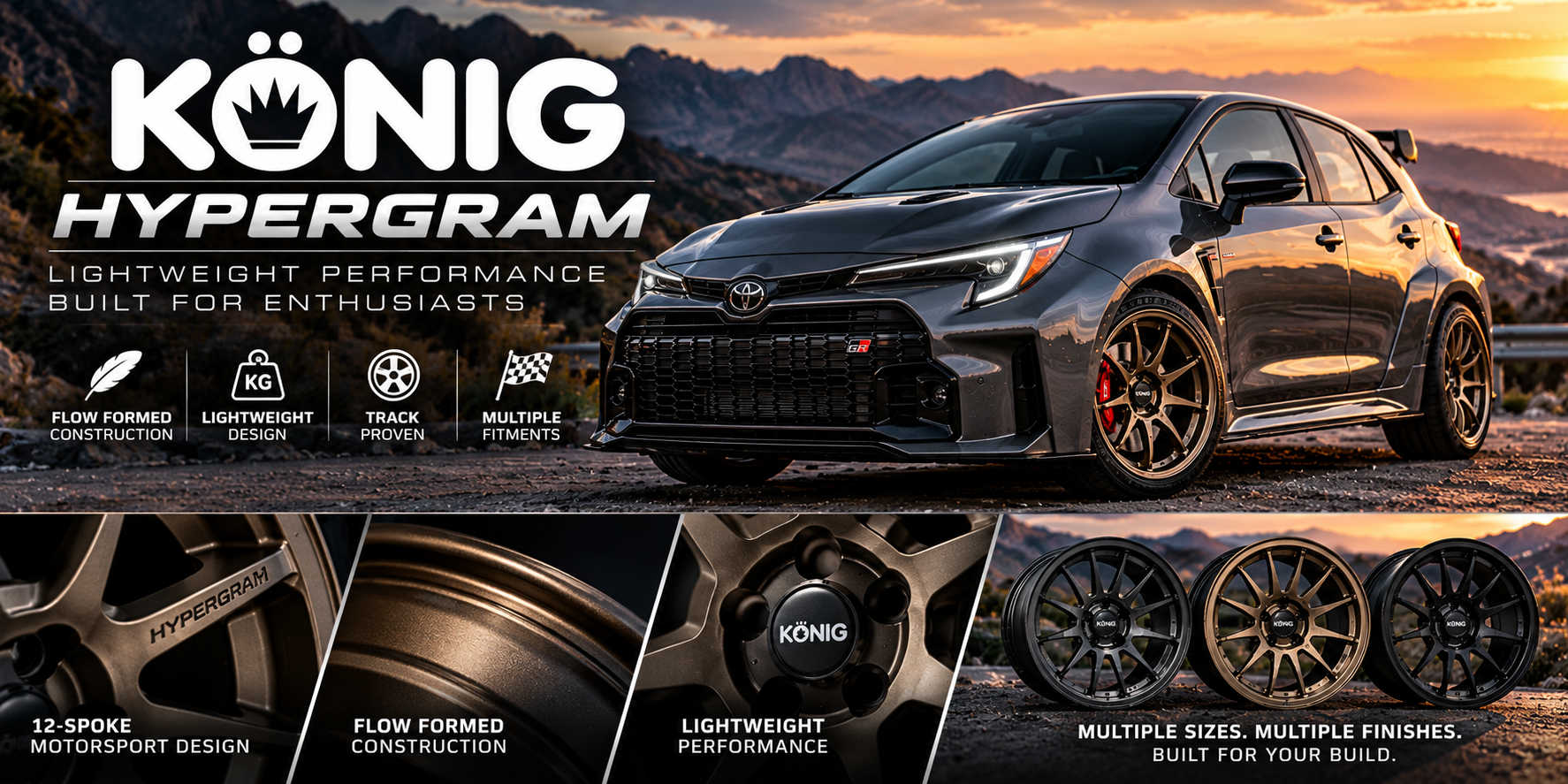
The Konig Hypergram combines flow-formed construction, low weight, brake clearance, and aggressive sizing for everything from lightweight 4x100 cars to wide 5x114.3 street and track builds. Here’s how wheel width, offset, profile, weight, and tire choice affect the finished setup.
Performance wheels have to do several jobs at once.
They need to fit over the brakes, support the vehicle, position the tire correctly, survive real roads, and look right on the car.
For an enthusiast build, there is another consideration: weight.
A wheel is not simply something the car carries. It is unsprung mass that the suspension has to control and rotational mass that the engine has to accelerate and the brakes have to slow down.
That is part of what makes the Konig Hypergram so interesting.
The Hypergram uses flow-formed construction and is available in everything from compact 15-inch 4x100 fitments to wide 18- and 19-inch performance configurations.
That makes it useful for very different builds without abandoning the same lightweight, motorsport-inspired philosophy.
You can see that range directly in the Konig wheel lineup at Elite Wheels.
What Is the Konig Hypergram?
The Hypergram is a lightweight 12-spoke performance wheel from Konig.
It uses Konig's Flow Forming Technology rather than relying on a traditional cast barrel alone.
Konig offers the design in multiple:
- Diameters
- Widths
- Bolt patterns
- Offsets
- Face profiles
- Finishes
That range is one of the Hypergram's biggest strengths.
A Miata-style 4x100 build can use a compact lightweight version while a much wider rear-wheel-drive or track application can use a 9.5-, 10.5-, or even wider configuration from the same wheel family.
Motorsport-Inspired 12-Spoke Design
The Hypergram's thin 12-spoke layout gives it a very different appearance from a heavy luxury wheel.
The design is visually open, which exposes more of the brake package and gives the wheel a functional track-oriented look.
That open area can also be useful when checking brake hardware or allowing air to move around large rotors during performance driving.
What Does Flow Formed Mean?
The Hypergram begins as a cast wheel, but the barrel goes through an additional forming process.
Konig describes Flow Forming Technology as applying pressure to the inner barrel while the wheel is spinning and heated.
The barrel is stretched to its final width while the material is compressed.
Why Do This?
The process changes the material structure of the barrel and allows Konig to produce a wheel that is lighter while maintaining the strength required for the application.
Konig describes the process as creating properties closer to forged aluminum than a conventional cast barrel.
Is Flow Formed the Same as Fully Forged?
No.
A flow-formed wheel and a fully forged wheel are manufactured differently.
The Hypergram still begins from a cast center section, while the barrel is subsequently flow formed.
A fully forged wheel begins from forged aluminum material that is shaped under tremendous pressure.
That distinction matters, but it does not make flow forming a bad compromise.
For many street and track builds, flow-formed wheels provide an attractive combination of weight, strength, sizing, and price.
How Light Is a Konig Hypergram?
The answer depends heavily on the exact size.
This is where looking at actual specifications becomes useful.
15x8 Hypergram
The Konig Hypergram 15x8 4x100 ET35 in Matte Grey is one of the smaller configurations available from Elite Wheels.
Konig lists this wheel at approximately 12.1 pounds.
That is an extremely low wheel weight compared with many larger factory and aftermarket wheel packages.
18x8.5 Hypergram
The Hypergram 18x8.5 5x114.3 ET35 is considerably larger but is still listed by Konig at approximately 20.08 pounds.
18x9.5 Hypergram
Move up to the 18x9.5 5x114.3 ET35 Hypergram and Konig lists the wheel at approximately 19.17 pounds.
18x10.5 Hypergram
The wider 18x10.5 5x114.3 ET25 Race Bronze Hypergram is listed at approximately 19.06 pounds.
Those numbers demonstrate an important point: wheel weight does not simply increase in a straight line with width.
Face profile, barrel design, offset, center geometry, and the exact engineering of the wheel all influence final weight.
Why Does Wheel Weight Matter?
Reducing wheel weight can influence several parts of the vehicle at once.
Unsprung Mass
The wheel, tire, brake rotor, hub, and portions of the suspension make up the vehicle's unsprung mass.
The suspension has to move and control that mass whenever the tire encounters a bump.
Reducing unnecessary unsprung weight can help the suspension respond more effectively to road changes.
Rotational Mass
The wheel is also rotating.
The engine and drivetrain have to accelerate it every time the car gains speed.
The brakes have to slow it every time the car stops.
This means wheel mass affects the vehicle differently from an equivalent amount of weight sitting motionless in the trunk.
Steering Feel
On the front axle, wheel-and-tire mass can also influence the feel of steering response and how quickly the suspension reacts to road inputs.
The difference may not transform every car, but it becomes increasingly relevant when replacing a particularly heavy factory wheel.
Does the Lightest Wheel Automatically Win?
No.
Weight is only one specification.
A wheel also needs adequate:
- Load capacity
- Brake clearance
- Impact resistance
- Correct offset
- Tire support
- Hub compatibility
A wheel that saves two pounds but does not clear the brake caliper is useless.
Likewise, an extremely light wheel designed for a small sports car may not have the load rating required by a significantly heavier vehicle.
What Is the Difference Between Hypergram A and B Profiles?
Konig produces Hypergrams with different face profiles.
This affects both appearance and brake clearance.
A Profile
Konig describes the A profile as the less-concave design.
The advantage is additional caliper clearance.
This makes the A profile useful for many front applications where large brake packages occupy considerable space behind the spokes.
For example, Konig identifies the 18x9.5 ET35 Hypergram as an A-profile configuration.
B Profile
The B profile creates a more concave wheel face.
That can look significantly more aggressive, but increased concavity can reduce the space available for certain brake calipers.
The 18x10.5 ET25 Race Bronze Hypergram is a B-profile configuration.
Why This Matters for Staggered Builds
A car may use an A-profile front wheel for brake clearance and a deeper B-profile wheel at the rear where caliper clearance is less restrictive.
This can create a visually staggered appearance even beyond the difference in wheel width.
But face profile should never be chosen solely because deeper concavity looks better.
The wheel still has to physically clear the brakes.
Why Is Brake Clearance Different From Wheel Diameter?
A common misconception is that any 18-inch wheel will clear a brake package simply because the factory wheel is also 18 inches.
That is not necessarily true.
Barrel Clearance
The brake rotor and caliper need sufficient room inside the wheel barrel.
Spoke Clearance
The caliper can also extend outward toward the back of the spokes.
This means spoke curvature and face profile matter just as much as diameter.
Big-Brake Kits Increase the Challenge
An aftermarket big-brake kit may move the caliper farther outward or use a physically larger caliper than the original system.
A wheel that cleared the factory brakes may no longer fit.
Test fitment or a brake-clearance template is especially valuable on modified cars.
What Does 18x8.5 +35 Mean?
The 18x8.5 +35 Hypergram gives us a good example.
18-Inch Diameter
The wheel accepts an 18-inch tire.
Eighteen inches is one of the most popular modern performance-wheel diameters because it offers broad tire availability while retaining more sidewall than many 19- or 20-inch setups.
8.5-Inch Width
The wheel measures 8.5 inches wide between the tire bead seats.
This can support a range of performance tire widths depending on the tire manufacturer's approved rim-width specifications.
+35mm Offset
The mounting surface sits 35 millimeters toward the outside of the wheel relative to its centerline.
That number does not tell you by itself whether the wheel will sit tucked, flush, or aggressive.
The vehicle's original wheel dimensions and suspension geometry still determine the final position.
What Changes When You Move to 18x9.5?
The 18x9.5 +35 Hypergram shares the same diameter and offset as the 18x8.5 +35 example but adds a full inch of wheel width.
That extra inch has to go somewhere.
The Wheel Extends Both Directions
When width increases while offset remains unchanged, the additional width is distributed across both the inner and outer sides of the wheel.
That means the wheel moves:
- Closer to suspension components on the inside
- Closer to the fender on the outside
More Tire Potential
The wider wheel can support wider performance tires within the tire manufacturer's approved range.
That may provide additional traction on a vehicle capable of using the extra tire.
But the chassis still needs enough physical clearance.
What About the 18x10.5 +25 Hypergram?
The 18x10.5 +25 Race Bronze Hypergram moves into much more aggressive territory.
The wheel is two inches wider than the 18x8.5 example and also uses a lower offset.
More Width
A 10.5-inch wheel provides the foundation for a significantly wider tire package.
Lower Offset
The +25 offset positions the wheel differently from a +35 configuration.
Combined with the additional width, the outer face can sit substantially farther outward depending on the vehicle.
Not a Universal Fitment
This is exactly the kind of wheel that should be chosen around a known vehicle fitment rather than purchased because the specification sounds aggressive.
Suspension clearance, fender clearance, alignment, tire width, and ride height all become critical.
Why Is 15x8 Still Relevant?
Modern car culture tends to associate performance wheels with large diameters.
But on a lightweight compact car, a small wheel can make much more sense.
The 15x8 4x100 ET35 Hypergram is a good example.
More Tire Sidewall
A 15-inch wheel leaves room for a taller sidewall while maintaining an appropriate overall tire diameter on many small platforms.
That can improve compliance over rough surfaces and provide additional protection against potholes.
Very Low Wheel Weight
Konig lists this wheel at roughly 12.1 pounds.
On a lightweight car, that can help preserve the responsive character enthusiasts often want from the chassis.
Broad 4x100 Appeal
4x100 is common across many older and smaller enthusiast platforms.
But bolt pattern alone still does not establish fitment.
Center bore, brake clearance, offset, suspension clearance, and tire dimensions all need to be checked.
Is 18 Inches Better Than 19 Inches for Performance?
Not universally, but 18-inch wheels have several practical advantages on many cars.
More Sidewall
If overall tire diameter remains similar, an 18-inch wheel provides more tire sidewall than a 19-inch wheel.
That can improve ride quality and impact resistance.
Tire Availability
Many performance tire manufacturers offer extensive 18-inch sizing because it remains popular in autocross, time attack, track days, and enthusiast street builds.
Potential Weight Savings
A smaller wheel can sometimes be lighter than a comparable larger wheel, although exact design and construction matter.
Brake Clearance Can Decide for You
A car with very large brakes may simply require 19-inch wheels.
The correct diameter is therefore the smallest wheel that meets your performance, tire, brake-clearance, and appearance requirements—not automatically the smallest or largest available.
Square or Staggered Hypergram Setup?
The Hypergram's wide range of sizes makes both possible.
Square Setup
A square setup uses the same wheel and tire size at all four corners.
This can allow front-to-rear rotation and is particularly attractive on track cars where maximizing front grip and managing tire wear matter.
A set of four 18x8.5 Hypergrams or four 18x9.5 Hypergrams could form the basis of a square setup where the vehicle supports those dimensions.
Staggered Setup
A staggered setup can use a narrower front and wider rear configuration.
That approach can make sense on powerful rear-wheel-drive cars where the rear axle needs more tire.
The Hypergram lineup makes combinations possible, but the front and rear wheel specifications should be selected around the specific chassis rather than simply pairing two wheels because they share the same design.
How Do You Choose the Right Tire Width?
The tire and wheel should be selected together.
Use the Approved Rim-Width Range
Every tire size has a range of wheel widths approved by the tire manufacturer.
Stay within that range.
Do Not Stretch for Appearance Alone
An excessively stretched tire can alter sidewall support and reduce wheel protection.
The tire should be chosen around performance and fitment rather than simply trying to expose the wheel lip.
Do Not Squeeze an Oversized Tire Onto a Narrow Wheel
The opposite problem is equally important.
A tire that is too wide for the wheel may cause the sidewalls to bulge and prevent the tread from behaving as intended.
More tire width does not automatically mean more usable grip.
What Does Center Bore Mean on a Hypergram?
Many Hypergram applications use a center bore larger than the vehicle hub.
For example, the 5x114.3 Hypergrams linked above use a 73.1mm center bore.
Why Use a Larger Center Bore?
A larger bore allows one wheel specification to physically clear the hubs of multiple compatible vehicle platforms.
When the vehicle hub is smaller, a hub-centric ring may be used to fill the difference.
Hub Rings Help Center the Wheel
The ring helps locate the wheel concentrically on the hub during installation.
It does not change the bolt pattern, offset, load rating, or brake clearance.
It solves one specific dimension: the difference between wheel center bore and vehicle hub diameter.
How Important Is Load Rating?
Wheel load capacity should always meet the needs of the vehicle.
Konig lists many of the 5x114.3 Hypergram configurations discussed here at a maximum load of approximately 1,521 pounds per wheel.
The smaller 15x8 4x100 example is rated differently because it is intended for another vehicle class.
Do Not Assume a Lightweight Wheel Fits a Heavy Car
A wheel can physically match the bolt pattern and still be inappropriate if its load rating does not meet the vehicle's requirements.
This is particularly important when adapting enthusiast wheels to heavier vehicles that were not the design's original target.
What Should You Check Before Ordering Hypergrams?
Before ordering, confirm:
- Vehicle year, make, model, and trim
- Wheel diameter
- Wheel width
- Bolt pattern
- Offset
- Center bore
- Load rating
- Brake-caliper clearance
- Suspension clearance
- Fender clearance
- Desired tire size
- Ride height
- Alignment
- Square or staggered configuration
Modified Cars Need Extra Attention
Coilovers, lowering springs, oversized brakes, wheel spacers, aggressive camber, and altered bodywork can all change available clearance.
A wheel that fits a stock version of a car may not fit the modified version sitting in your garage.
Test-Fit When Necessary
If brake or suspension clearance is close, test fitment is worth the effort before mounting tires.
Once tires are mounted, return options can become more limited.
Who Is the Konig Hypergram Best For?
The Hypergram makes the most sense for enthusiasts who care about the actual performance characteristics of a wheel rather than appearance alone.
It is especially attractive for:
- Autocross cars
- Track-day builds
- Lightweight street cars
- JDM performance builds
- Cars using wider performance tires
- Owners replacing heavy factory wheels
- Drivers who want flow-formed construction without moving directly into forged-wheel pricing
Is the Konig Hypergram Worth Considering?
If your priorities include low wheel weight, useful performance sizing, brake clearance, and a proven motorsport-inspired design, the Hypergram deserves a place on the shortlist.
The range is broad enough that “Hypergram” does not describe one single fitment.
A 12-pound 15x8 4x100 wheel and an 18x10.5 B-profile wheel are very different products even though they share the same design family.
That is part of what makes the Hypergram useful.
You can choose the version around the vehicle instead of forcing one specification onto every build.
Choose the Hypergram Around the Car
If you are building a lightweight 4x100 car, start with the 15x8 ET35 Matte Grey Hypergram.
For a moderate 18-inch 5x114.3 setup, compare the 18x8.5 +35 and 18x9.5 +35 configurations.
For something substantially wider and more aggressive, the 18x10.5 +25 Race Bronze Hypergram shows how far the same design can be pushed.
You can also browse Konig at Elite Wheels or compare the complete Konig wheel catalog before choosing the exact dimensions for your build.