Gram Lights 57NR: Why This 10-Spoke Wheel Is Built for Real Performance
The Gram Lights 57NR combines a motorsport-inspired 10-spoke design with added rim strength, bead-seat knurling, and performance-focused sizing. Here’s how it differs from the 57DR and 57CR, what its construction actually does, and how to choose the right fitment for your build.
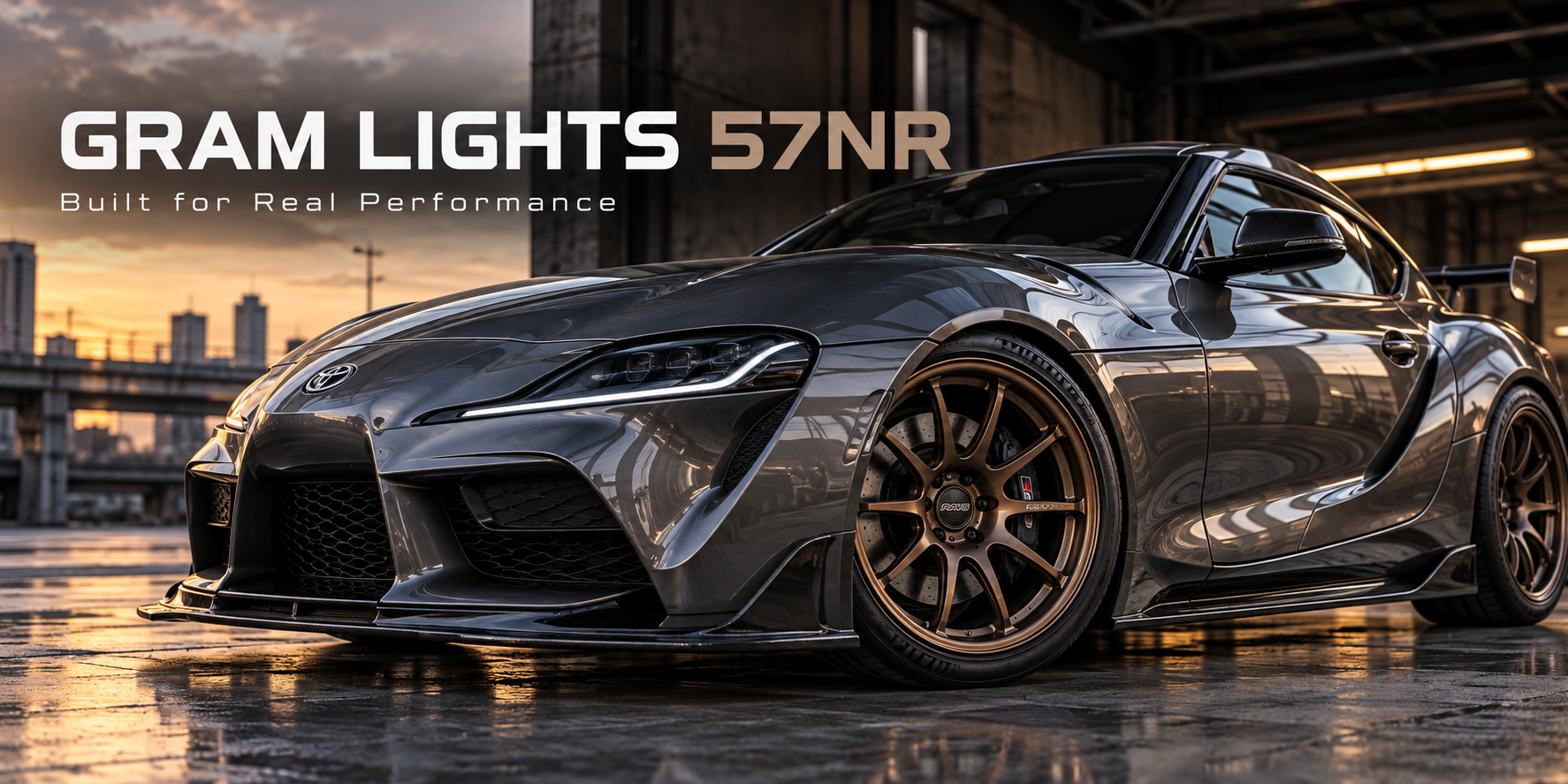
Some wheel designs become popular because they look good parked.
Others are designed around what happens when the car is actually being driven hard.
The Gram Lights 57NR falls into the second category.
RAYS developed the 57NR as part of the Gram Lights R Series, building it around a traditional 10-spoke layout, increased inner-rim strength, and features intended to support high-grip tires and serious motorsport use.
That makes the Gram Lights 57NR 18x9.5 +38 in Dark Bronze much more than another aggressive-looking aftermarket wheel.
But the 57NR is not automatically the right wheel for every car. Width, offset, bolt pattern, brake clearance, tire size, suspension, and the way the car is used all determine whether the setup actually works.
What Is the Gram Lights 57NR?
The 57NR is a one-piece cast performance wheel from RAYS' Gram Lights lineup.
It was developed as part of the same R Series family that includes familiar models such as the 57CR and 57DR, but RAYS designed the 57NR with a different structural approach.
The most obvious difference is the 10-spoke face.
Why 10 Spokes?
The spoke layout is not only a styling decision.
RAYS describes the 10-spoke design as a way to distribute loads across the wheel while maintaining rigidity under the forces generated during acceleration, braking, and cornering.
For a performance car running modern high-grip tires, those forces can be substantial.
A tire capable of generating more grip also transfers more load into the wheel, suspension, hubs, and chassis.
The C-FORM Design
Between the spokes, the 57NR uses what RAYS calls its C-FORM design.
This structural shape is intended to increase rigidity and help the wheel retain its shape under heavy loading.
The important idea is not that a wheel should simply be stiff everywhere. It is that the design should place material where it contributes to strength without adding unnecessary mass everywhere else.
What Is H.S.PLUS?
One of the major engineering changes introduced with the 57NR is RAYS' H.S.PLUS technology.
The system focuses on increasing strength in the inner rim.
Why the Inner Rim Matters
The inner barrel of a wheel takes substantial abuse.
Potholes, curbing, track surfaces, road impacts, tire loads, and suspension movement all place stress on the rim.
That becomes even more important with performance tires because higher grip allows the vehicle to generate greater cornering and braking forces before the tire begins to slide.
RAYS developed the 57NR with additional inner-rim strength to support those demands.
Performance Is More Than Wheel Weight
Enthusiasts often focus heavily on weight when comparing wheels.
Weight matters, but it is only part of the equation.
A performance wheel also needs enough strength and rigidity to handle the forces the vehicle creates.
The goal is not simply the lightest wheel possible. The goal is an effective balance between weight, stiffness, strength, fitment, and durability.
Why Does the 57NR Use Knurling?
The 57NR uses a knurled finish on the tire bead seat.
That detail is easy to overlook because it disappears once the tire is mounted.
It can still matter significantly on a high-grip setup.
Tires Can Move on the Wheel
Under strong acceleration or braking, the tire can experience enough force to move slightly relative to the wheel.
This is more likely on high-powered vehicles, sticky tires, and cars used in competition.
Even small amounts of tire movement can alter the wheel-and-tire balance or reduce the precision of power transfer.
Knurling Adds Grip at the Bead Seat
The textured bead-seat surface is designed to help resist that movement.
For an ordinary commuter car, this may never become a meaningful issue.
For a high-horsepower street car, drift car, autocross setup, or track build, it is exactly the kind of small detail that shows where the wheel's priorities are.
What Is the EH2+ Bead Hump?
Certain 57NR sizes also use an EH2+ hump profile at the bead seat.
RAYS developed this feature around situations where performance drivers may run relatively low tire pressures.
Why Low Pressure Creates a Risk
Lower tire pressure allows more sidewall movement.
In extreme conditions, especially during aggressive lateral loading, there is a greater risk of the tire bead moving away from its intended position on the wheel.
EH2+ Helps Retain the Bead
The hump profile adds another physical barrier intended to help keep the bead seated.
RAYS currently specifies this feature on selected 57NR sizes, including certain 18x9.5 and 19x10.5 configurations.
This is another example of why the 57NR's design is more performance-oriented than its appearance alone suggests.
How Does the 57NR Compare With the 57DR?
The Gram Lights 57DR is probably one of the most recognizable designs in the R Series.
It uses six primary spokes instead of the 57NR's ten-spoke layout.
That makes the two wheels visually very different even when the dimensions are similar.
57DR: Simple Six-Spoke Design
The 57DR has a very clean motorsport appearance.
Its relatively open face exposes more of the brake package and gives the wheel the classic six-spoke look associated with many Japanese performance cars.
Elite Wheels currently carries the Gram Lights 57DR 18x9.5 +38 in Semi Gloss Black, which provides a useful direct comparison with the 57NR in the same basic 18x9.5 +38 sizing.
57NR: More Spokes and Added Structural Features
The 57NR uses ten spokes along with the newer C-FORM and H.S.PLUS engineering.
Visually, it creates a denser, more technical-looking wheel face.
From a performance standpoint, RAYS specifically developed the 57NR around increased rigidity and improved inner-rim strength.
If you like the visual simplicity of six spokes, the 57DR may be the stronger aesthetic choice. If you want the newer 10-spoke R Series design and its additional structural features, the 57NR is the more obvious option.
How Does the 57NR Compare With the 57CR?
The 57CR moves in the opposite direction visually.
It uses five spokes.
RAYS describes the 57CR as a classic sports-wheel design derived from the earlier Gram Lights 57C.
The Five-Spoke Advantage
A five-spoke design creates large open areas between the spokes.
That gives the car a simpler visual appearance and puts more of the brake rotor and caliper on display.
For a build with large brakes or a strong emphasis on classic motorsport styling, this can look especially good.
Elite Wheels currently lists the Gram Lights 57CR 19x10.5 +35 in Glossy Black for drivers who prefer that five-spoke approach.
57CR vs. 57DR vs. 57NR
A simple way to think about the three designs is:
- 57CR: classic five-spoke performance styling
- 57DR: clean six-spoke motorsport styling
- 57NR: newer 10-spoke design focused heavily on rigidity and traction demands
The correct choice is not just about which one is technically newer. The wheel still has to fit the vehicle and match the way you want the car to look.
Is the Gram Lights 57NR Forged?
No.
The standard 57NR is a one-piece cast wheel.
This is an important distinction because Gram Lights and RAYS are sometimes discussed alongside forged wheels from RAYS' Volk Racing lineup.
They are not the same construction method.
Cast Does Not Mean Cheap
Wheel construction should not be reduced to the idea that forged is always good and cast is always bad.
Design, manufacturing quality, testing, material placement, load rating, and the intended use all matter.
Gram Lights wheels are positioned as performance-oriented cast wheels with designs developed around motorsport experience.
Why Choose Gram Lights?
For many enthusiasts, Gram Lights occupies an appealing middle ground.
You get recognizable RAYS engineering and motorsport-focused designs without moving into the significantly higher price range associated with many fully forged wheels.
You can compare the current Gram Lights lineup at Elite Wheels to see how the different R Series models and sizes compare.
What Does an 18x9.5 +38 57NR Actually Mean?
The exact product featured here is an 18x9.5 +38 wheel with a 5x114.3 bolt pattern.
Every part of that specification matters.
18-Inch Diameter
The wheel is 18 inches in diameter.
Eighteen inches is a popular performance size because it can provide enough brake clearance for many modern performance cars while retaining more tire sidewall than a larger 19- or 20-inch setup.
9.5-Inch Width
A 9.5-inch-wide wheel provides room for significantly wider performance tires than many factory wheel packages.
The correct tire width still depends on the tire manufacturer's approved wheel-width range and the available vehicle clearance.
+38mm Offset
Offset determines where the mounting surface sits relative to the centerline of the wheel.
A +38mm offset cannot be judged by itself.
The same 18x9.5 +38 wheel may fit one vehicle extremely well while requiring suspension or fender changes on another.
5x114.3 Bolt Pattern
5x114.3 is common across many Japanese and other performance platforms.
However, matching the bolt pattern does not automatically mean the wheel fits.
Center bore, brakes, offset, tire dimensions, suspension geometry, and body clearance still need to be checked.
Which Cars Are Good Candidates for an 18x9.5 Performance Wheel?
This general size is popular on several performance platforms, but the exact fitment needs to be confirmed vehicle by vehicle.
Subaru WRX and STI
Many Subaru performance builds use 18-inch wheels with wider tire packages.
Fitment changes substantially by generation, suspension setup, brake package, and ride height, so the vehicle needs to be checked rather than assuming every WRX or STI accepts the same configuration.
Honda Civic Type R
The Civic Type R is another platform where enthusiasts commonly move toward lightweight and performance-focused wheel setups.
Brake clearance is especially important because the large factory calipers limit which wheel designs work.
Mitsubishi Evolution
Evo builds have long used wide 18-inch wheel-and-tire packages for street, track, and time-attack applications.
Again, width and offset have to work with the exact generation, suspension, alignment, and tire size.
Nissan and Other 5x114.3 Platforms
Many Nissan, Infiniti, Hyundai, Toyota, and Lexus performance platforms also use 5x114.3 bolt patterns.
That does not make the 57NR universal.
Always start with the specific car.
How Should You Choose the Tire for a 57NR?
A performance wheel only works properly when the tire is matched to it.
Start With Approved Rim Width
Tire manufacturers publish an approved wheel-width range for every tire size.
Use that range rather than choosing tire width based only on appearance.
Think About Your Goal
A daily-driven performance car may prioritize:
- Ride comfort
- Wet traction
- Tread life
- Road noise
A track-focused setup may place more emphasis on:
- Maximum dry grip
- Sidewall stiffness
- Heat tolerance
- Steering response
More Tire Is Not Always Better
A tire that is too wide for the wheel can reduce steering precision and distort the intended tread shape.
A tire stretched excessively onto a wide wheel creates a different set of problems.
The goal is a properly supported tire that fits the vehicle.
What Does Wheel Weight Actually Change?
Performance-wheel discussions often become obsessed with a single weight number.
There is a reason weight matters—but context is important.
Unsprung Mass
Wheels and tires are part of the vehicle's unsprung mass.
The suspension has to control that mass as the wheel moves over the road.
Reducing unnecessary unsprung weight can help the suspension respond more effectively.
Rotational Mass
The wheel also rotates.
The drivetrain has to accelerate it, and the brakes have to slow it down.
That means reducing wheel mass can influence the way the vehicle accelerates, brakes, and changes direction.
Do Not Ignore Strength
The lightest possible wheel is not automatically the best performance wheel.
If the vehicle is generating substantial grip, the wheel also needs to withstand the loads being transmitted through the tire.
This is exactly why features such as the 57NR's C-FORM design and strengthened inner rim matter.
Street or Track: Who Is the 57NR For?
The 57NR can work on both, but the ideal fitment may be different.
Street Build
For a street car, choose a wheel-and-tire combination that preserves usable clearance and enough tire sidewall for the roads you actually drive.
An aggressive flush fitment may look great while parked, but rubbing every time the suspension compresses does not make the car better.
Track Build
Track use places greater emphasis on:
- Tire availability
- Brake clearance
- Wheel strength
- Wheel weight
- Square fitment options
- Ability to rotate tires
An 18-inch setup is often attractive because many serious performance tires are readily available in that diameter.
Drift Build
The 57NR's engineering is particularly relevant to drift applications.
Strong lateral loading, large power delivery, lower tire pressures, and rapid transitions place significant demands on the wheel and tire interface.
Features such as bead-seat knurling and the EH2+ hump on applicable sizes directly address those types of conditions.
What Should You Check Before Ordering?
Before buying any 57NR—or any aftermarket wheel—confirm the complete fitment.
Check:
- Vehicle year, make, model, and trim
- Bolt pattern
- Center bore
- Wheel diameter
- Wheel width
- Offset
- Front brake clearance
- Rear brake clearance
- Suspension clearance
- Fender clearance
- Tire size
- Ride height
- Alignment settings
Modified Cars Need More Checking
Coilovers, lowering springs, oversized brakes, spacers, wide tires, and aggressive alignment settings can all change what fits.
A wheel that fits a factory car perfectly may not fit the same model after major suspension or brake changes.
Do Not Order From Bolt Pattern Alone
This is one of the easiest wheel-buying mistakes to avoid.
A 5x114.3 wheel can physically share a bolt pattern with many vehicles while still being completely wrong in offset, center bore, width, or brake clearance.
Is the Gram Lights 57NR Worth Considering?
If you want a wheel that combines modern Japanese motorsport styling with real performance-focused engineering, the 57NR deserves serious consideration.
Its ten-spoke layout, C-FORM structure, H.S.PLUS inner-rim strengthening, bead-seat knurling, and available EH2+ bead-retention features show that the wheel was designed around more than appearance.
At the same time, the 57NR still has to be selected correctly.
The wrong width or offset can turn a very good wheel into a bad setup.
The right one can give the car a stronger stance, support a serious tire package, and fit naturally into a street, track, or competition build.
Choose the Wheel Around the Way You Drive
There is no single best wheel for every performance car.
The best choice depends on what the vehicle is expected to do.
If you want the newer 10-spoke R Series design and the additional engineering RAYS built into the 57NR, start by checking the Gram Lights 57NR 18x9.5 +38 Dark Bronze at Elite Wheels.
If you prefer another R Series style, compare it with the 57DR 18x9.5 +38 or the 57CR 19x10.5 +35.
You can also browse the full Gram Lights lineup or explore the complete wheel catalog at Elite Wheels before deciding which setup fits your build.