Enkei T6R Wheels: Why the Six-Spoke MAT Design Works for Street and Track Builds
The Enkei T6R combines a clean six-spoke design with MAT rim-forming technology, useful 17- and 18-inch sizing, multiple bolt patterns, and widths up to 9.5 inches. Here’s how the T6R compares with wheels like the RPF1 and NT03+M, what its fitment numbers mean, and how to choose the right setup for your car.
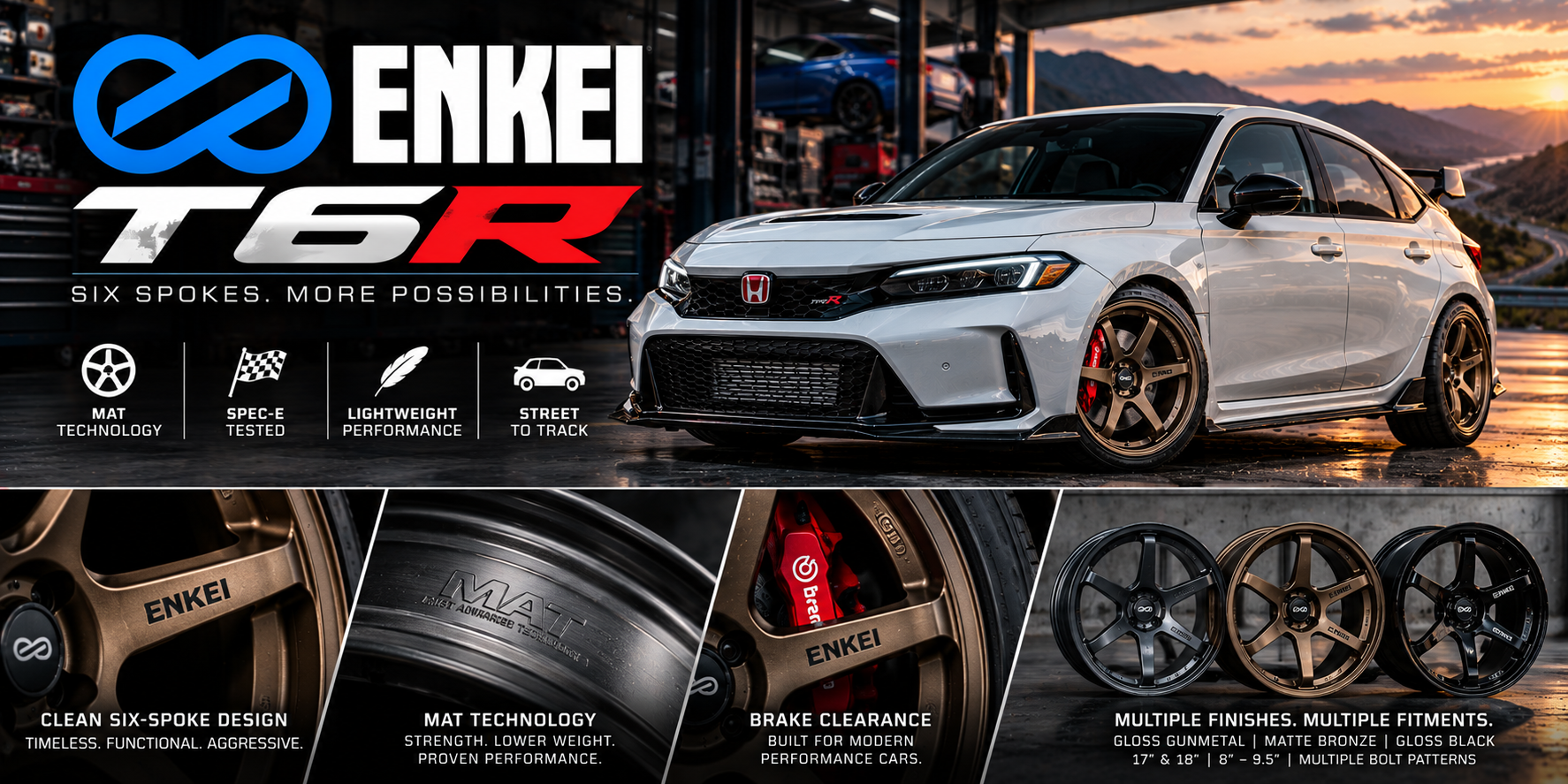
Some performance wheels become popular because they are visually complicated.
The Enkei T6R goes in the opposite direction.
Six spokes. A clean face. Useful performance sizes. Enough concavity to look aggressive without turning the wheel into a styling exercise.
Underneath that simple design, though, the T6R uses Enkei's MAT rim-forming technology and is offered in configurations aimed directly at modern enthusiast cars.
The Enkei T6R 18x8.5 +45 5x100 in Gloss Gunmetal is one real example currently carried by Elite Wheels.
It is the kind of wheel that makes sense on a build where appearance matters, but so do brake clearance, tire choice, wheel width, offset, and how the car actually drives.
What Is the Enkei T6R?
The T6R is part of Enkei's Tuning Series.
Enkei developed it as a six-spoke counterpart to the five-spoke TS-5, using the same general philosophy of clean styling and performance-oriented sizing.
The current T6R lineup includes 17- and 18-inch diameters, widths ranging from 8 to 9.5 inches, and fitments for several common performance-car bolt patterns.
Six-Spoke Design
The most obvious feature is the simple six-spoke face.
Each spoke extends strongly toward the outside of the rim, creating a wheel that looks larger and more open than a dense multi-spoke design.
That openness also puts more of the brake rotor and caliper on display.
Built for Modern Performance Cars
Enkei specifically positions the T6R for vehicles such as the Civic Type R, Subaru WRX and STI, Infiniti Q50 and Q60, Volkswagen GTI, and other modern sports coupes and sedans.
That does not mean every T6R fits every one of those vehicles.
The correct diameter, width, bolt pattern, offset, center bore, and brake clearance still need to be matched to the exact car.
What Is Enkei MAT Technology?
The T6R uses Enkei's Most Advanced Technology, commonly called MAT.
MAT combines a cast wheel center with a rim-forming process.
How the Process Works
After the wheel is cast, the rim section is formed using a spinning process.
Pressure is applied to the barrel as the wheel rotates, shaping the material into its final form.
Enkei says this process improves the material properties of the rim while allowing the wheel to maintain the strength required for performance use.
Why Rim Forming Matters
The barrel of a wheel has to deal with road impacts, tire loads, cornering forces, and repeated stress.
Using additional forming after casting allows Enkei to engineer the rim differently than it would with a basic cast-only process.
The goal is not simply to make the wheel as thin as possible.
The goal is to place material efficiently while maintaining the required strength.
Is MAT the Same as a Fully Forged Wheel?
No.
This distinction is important because the terms surrounding wheel manufacturing can become confusing.
A MAT wheel begins with a cast wheel structure and then uses Enkei's rim-forming process.
A fully forged wheel begins with forged aluminum that is shaped under extremely high pressure.
Why Choose MAT?
For many enthusiasts, MAT occupies an appealing middle ground.
You get more sophisticated barrel construction than a basic conventional cast wheel without automatically moving into the cost of a premium fully forged wheel.
That makes MAT wheels particularly attractive for:
- Daily-driven performance cars
- Track-day builds
- Autocross cars
- Modified street cars
- Drivers replacing heavy factory wheels
What Is Enkei Spec-E Testing?
Construction is only useful if the finished wheel can survive the loads placed on it.
Enkei tests its wheels under its own Spec-E standard.
According to Enkei, Spec-E requires more severe testing than the standard JWL requirement.
More Demanding Impact Testing
Enkei uses a higher drop point during its impact testing.
More Fatigue Cycles
Enkei also states that its rotary-bending and dynamic-radial fatigue tests use approximately 20 percent more cycles than JWL requirements.
The point is not that a performance wheel is indestructible.
Any wheel can be damaged by a sufficiently hard impact.
The important part is that the wheel is engineered and tested around real structural loads rather than appearance alone.
What Sizes Does the T6R Come In?
The current T6R family covers several common enthusiast fitments.
Enkei offers configurations including:
- 17x8
- 17x9
- 18x8
- 18x8.5
- 18x9.5
Available bolt patterns include several 5x100, 5x112, 5x114.3, and 5x120 applications depending on size.
You can browse the current Enkei lineup at Elite Wheels to compare available T6R and other Enkei configurations.
What Does 18x8.5 +45 Mean?
The T6R 18x8.5 +45 5x100 gives us a practical example.
18-Inch Diameter
The wheel is designed for an 18-inch tire.
Eighteen inches is especially popular on modern performance cars because it can provide enough room for substantial brake packages while retaining more tire sidewall than a comparable 19- or 20-inch setup.
8.5-Inch Width
The wheel measures 8.5 inches between its bead seats.
That width can support several common performance-tire sizes, but the tire manufacturer's approved rim-width range should always determine which tire is appropriate.
+45mm Offset
The +45mm offset describes where the mounting surface sits relative to the wheel centerline.
It does not tell you by itself whether the wheel will sit tucked, flush, or aggressive.
Wheel width, factory hub position, suspension geometry, and tire dimensions all affect the final location.
What Does 5x100 Mean?
The featured T6R uses a 5x100 bolt pattern.
Five Lug Holes
The first number indicates five wheel studs or bolts.
100mm Bolt Circle
The second number describes the diameter of the bolt circle.
5x100 is used by several Subaru, Toyota, Volkswagen, and other enthusiast platforms depending on model and year.
But sharing a bolt pattern does not automatically establish fitment.
A wheel may still be wrong because of:
- Offset
- Center bore
- Width
- Brake clearance
- Load rating
Why Does the 72.6mm Center Bore Matter?
The T6R example linked above uses a 72.6mm center bore.
The center bore is the opening through the middle of the wheel that fits around the vehicle hub.
Some Cars Need Hub-Centric Rings
If the vehicle hub is smaller than the wheel's center bore, an appropriately sized hub-centric ring may be used to fill the difference.
Elite Wheels also carries Enkei hub rings and wheel accessories for several common hub dimensions.
What a Hub Ring Does Not Do
A hub ring cannot correct:
- The wrong bolt pattern
- The wrong offset
- Insufficient brake clearance
- Incorrect wheel width
- Insufficient load capacity
It addresses only the relationship between the center bore and the vehicle hub.
17-Inch or 18-Inch T6R?
The ideal diameter depends on the vehicle and the build.
Why Choose 17 Inches?
A 17-inch wheel can provide more tire sidewall for a given overall tire diameter.
That can offer:
- More compliance over rough roads
- Additional wheel protection
- Potentially lower tire cost
- Useful sizing for autocross and track applications
Why Choose 18 Inches?
An 18-inch wheel may be required to clear larger factory brakes.
It also opens up an enormous selection of modern performance tires and can provide a more aggressive visual proportion on newer vehicles.
The Brakes May Decide
The smallest wheel is not automatically the best performance wheel.
If it does not clear the brake package, it does not fit.
Brake clearance should be established before choosing diameter based on weight or tire sidewall alone.
8.5 Inches or 9.5 Inches Wide?
Wheel width has a major influence on tire fitment and available clearance.
18x8.5
An 8.5-inch wheel is a useful street-performance size for many vehicles.
It can support meaningful tire width without becoming excessively aggressive for a daily-driven car.
18x9.5
Moving to 9.5 inches creates room for a wider tire package.
That can be useful for track cars, higher-powered vehicles, or builds where maximum usable tire width is a priority.
But the extra inch of wheel width has to physically fit somewhere.
Width Changes Both Sides of the Wheel
If two wheels use the same offset but one is an inch wider, approximately half of that additional width moves inward and half moves outward.
That means wider wheels reduce clearance on both the suspension side and the fender side unless offset changes compensate for the difference.
Why Does the T6R Have Different Face Profiles?
Enkei's published T6R fitment chart identifies different face profiles depending on size.
The wider 18x9.5 configurations use a different profile from many narrower sizes.
Wider Wheels Can Create More Concavity
Additional width and the appropriate offset can allow the spokes to sweep more dramatically toward the wheel center.
That creates the deeper concave appearance many enthusiasts want.
Concavity Affects Brake Clearance
More concavity is not automatically better.
The shape of the spokes determines how much room is available for brake calipers behind the wheel face.
A flatter wheel may sometimes provide better clearance for a large front brake package.
How Does the T6R Compare With the Enkei RPF1?
The RPF1 is probably the wheel most enthusiasts immediately associate with Enkei.
The Enkei RPF1 18x9.5 +38 5x114.3 is one example currently carried by Elite Wheels.
RPF1: Motorsport Icon
The RPF1 uses Enkei's well-known split-spoke design and has become a staple of track, autocross, and street-performance builds.
It is often chosen by drivers who place maximum emphasis on a proven motorsport aesthetic and minimizing wheel mass.
T6R: Cleaner Six-Spoke Styling
The T6R takes a simpler visual approach.
Six large spokes create a stronger, less delicate appearance while still maintaining the open-face look expected from a performance wheel.
If you like the technical appearance of the RPF1, it remains difficult to beat.
If you prefer a cleaner six-spoke design, the T6R offers a very different personality while still using Enkei's MAT manufacturing philosophy.
How Does the T6R Compare With the NT03+M?
The Enkei NT03+M 18x8.5 +38 5x114.3 represents almost the opposite design direction.
NT03+M: Dense Motorsport Design
The NT03+M uses many thin spokes and a reinforcing perimeter ring.
Visually, it is much more complex than the T6R.
T6R: Minimalist Design
The T6R uses only six spokes.
That makes the brakes much more visible and creates a simpler overall wheel face.
Choosing between them is therefore not only a question of specifications.
The two wheels produce completely different visual effects on the same car.
What About the Enkei TSR-X?
The Enkei TSR-X 18x9.5 +38 in Gloss Bronze adds another option within the Enkei Tuning Series.
Ten-Spoke Layout
The TSR-X uses a more aggressive ten-spoke design.
Like the T6R, it uses Enkei's MAT rim-forming technology.
Which Design Is Better?
There is no technical rule saying six spokes, ten spokes, or split spokes automatically create the best wheel.
The correct choice comes down to:
- Available fitment
- Brake clearance
- Wheel weight
- Tire requirements
- Vehicle use
- Styling preference
This is one of the advantages of shopping within a manufacturer like Enkei: you can often change wheel style without completely changing the overall engineering philosophy behind the product.
Is the T6R Good for Track Use?
It can be, provided the exact wheel specification works for the vehicle and tire package.
A track wheel needs more than an aggressive design.
Brake Clearance
Large brake packages are common on track-oriented cars.
The wheel needs adequate barrel and spoke clearance.
Tire Availability
The chosen diameter and width should support the performance tire sizes you actually want to run.
Square Fitment
Many track drivers prefer the same wheel and tire size at all four corners so tires can be rotated to manage wear.
The T6R's 8-, 8.5-, 9-, and 9.5-inch configurations give builders several possible directions depending on the chassis.
Durability Matters
Track use repeatedly loads wheels under cornering and braking.
Enkei's MAT construction and Spec-E testing are therefore more meaningful than they would be on a wheel purchased only for parking-lot appearance.
Is the T6R Good for a Daily Driver?
Yes, and this may actually be where the T6R makes the most sense.
Simple to Clean
Six large spokes are easier to clean around than a wheel with an extremely dense multi-spoke face.
That sounds minor until brake dust becomes a weekly reality.
Useful Street Sizes
The T6R is available in widths that can support meaningful performance tires without forcing every car into an extreme fitment.
Multiple Finishes
Enkei offers the T6R in finishes including:
- Gloss Gunmetal
- Gloss Black
- Matte Bronze
That gives the same basic wheel very different personalities depending on the vehicle color.
Which Finish Should You Choose?
There is no performance difference worth choosing around here—the finish decision is mostly visual.
Gloss Gunmetal
Gunmetal gives the wheel definition without creating the extremely dark appearance of black.
It works particularly well on white, blue, red, silver, and darker-colored cars.
Gloss Black
Black creates a more aggressive appearance and blends naturally with black trim, splitters, diffusers, and dark window tint.
The tradeoff is that the individual spoke shapes can disappear visually in low light.
Matte Bronze
Bronze creates the strongest contrast and works especially well on blue, white, black, gray, and green vehicles.
It also gives the T6R a more obvious Japanese motorsport look.
What Tire Width Should You Run?
The answer depends on the wheel width and the car.
Use the Tire Manufacturer's Approved Range
Every tire size has a specified wheel-width range.
That should be the starting point.
Do Not Buy the Widest Tire Possible
A tire that is too wide for the wheel can distort the intended tread profile and reduce steering precision.
Likewise, excessive stretch can reduce wheel protection and alter sidewall behavior.
The Car Still Has to Clear It
A tire may fit the wheel perfectly while rubbing the suspension or fender on the vehicle.
Wheel width, offset, tire width, tire diameter, suspension height, and alignment all have to work together.
Will a T6R Fit Over a Big Brake Kit?
Possibly—but never assume.
Brake clearance depends on more than wheel diameter.
Radial Clearance
The rotor and caliper need enough room inside the wheel barrel.
Spoke Clearance
The caliper also extends outward toward the back of the wheel face.
Spoke curvature and face profile determine whether there is enough space.
Use a Brake Template When Available
For an aftermarket big-brake kit, a brake-clearance template is one of the best ways to verify fitment before mounting tires.
A wheel being 18 inches does not automatically mean it clears every 18-inch-compatible brake package.
What Should You Check Before Ordering?
Before buying a T6R, confirm:
- Vehicle year, make, model, and trim
- Wheel diameter
- Wheel width
- Bolt pattern
- Offset
- Center bore
- Brake clearance
- Load requirements
- Tire size
- Tire manufacturer's approved wheel-width range
- Suspension clearance
- Fender clearance
- Ride height
- Alignment
Modified Cars Need Extra Attention
Coilovers, lowering springs, big-brake kits, spacers, aggressive camber, and wide tires can all change what fits.
A wheel listed for the stock version of a platform may not automatically clear the modified version in your garage.
Is the Enkei T6R Worth Considering?
If you want a performance-oriented wheel without the visual complexity of a dense multi-spoke design, the T6R makes a strong argument.
It combines:
- A clean six-spoke face
- Enkei MAT rim-forming technology
- Spec-E testing
- 17- and 18-inch sizes
- Widths up to 9.5 inches
- Multiple common performance-car bolt patterns
- Three very different finishes
The T6R does not replace the RPF1, NT03+M, or every other Enkei wheel.
It gives you another way to build the same car.
Choose the Wheel Around the Build
If your car uses the appropriate 5x100 specification, start with the Enkei T6R 18x8.5 +45 Gloss Gunmetal.
If your priorities lean toward Enkei's most recognizable track-inspired design, compare it with the RPF1 18x9.5 +38.
For a more technical multi-spoke wheel, look at the NT03+M 18x8.5 +38.
Or compare the more modern ten-spoke TSR-X 18x9.5 +38.
You can also browse Enkei at Elite Wheels or explore all wheels at Elite Wheels before choosing the dimensions and design that actually fit your build.