Enkei RPF1 Wheels: Why the Lightweight Racing Design Still Works
The Enkei RPF1 has built its reputation around low weight, functional spoke design, and motorsport-inspired engineering. Learn how MAT construction, wheel weight, sizing, offset, brake clearance, and fitment all come together when choosing the right RPF1 for your build.
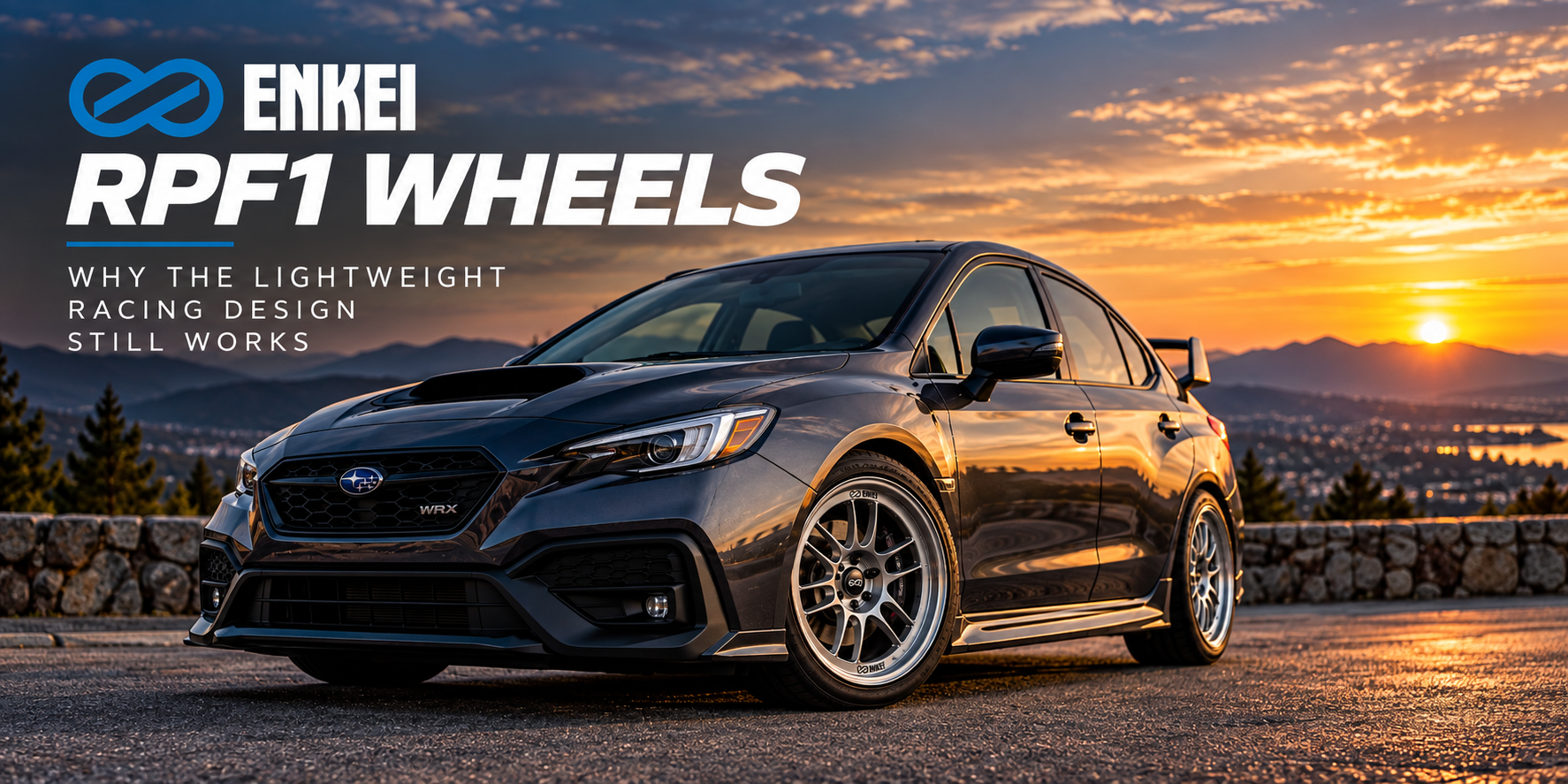
Some aftermarket wheels are chosen almost entirely for appearance. Others are designed around what happens when the car starts moving.
The Enkei RPF1 falls firmly into the second category.
Its lightweight construction, recognizable twin-spoke design, broad range of sizes, and performance-focused engineering have made it a natural choice for everything from daily-driven street cars to autocross and track builds.
That does not mean every RPF1 fits every car, or that the lightest wheel is automatically the best wheel for every build. Width, diameter, offset, bolt pattern, brake clearance, tire size, and the way the vehicle is actually used all matter.
If you are considering a set of Enkei wheels, understanding why the RPF1 was designed the way it was makes choosing the right setup much easier.
What Makes the Enkei RPF1 Different?
At first glance, the RPF1 is a relatively simple wheel. It does not rely on an extremely complicated spoke pattern or oversized styling details to stand out.
That simplicity is intentional.
Enkei designed the RPF1 around low weight, strength, rigidity, and the demands of performance driving. The result is a wheel that looks at home on a street car but does not feel out of place on a car built around lap times.
Twin-Spoke Design
The RPF1 uses six pairs of thin spokes rather than a few large, heavy spokes.
According to Enkei, the twin-spoke layout is designed to distribute stress during cornering, hard braking, and aggressive driving.
That engineering purpose is also what gives the RPF1 its signature appearance.
Instead of designing a wheel first and trying to make it perform afterward, the visual identity comes largely from the functional structure of the wheel itself.
Center Section Design
The center section uses pockets around the bolt circle to remove material from areas where it is not required.
This helps Enkei balance rigidity and weight while keeping the design compact around the hub.
Small details like this matter when the goal is reducing unnecessary mass without simply making every part of the wheel thinner.
What Is Enkei MAT Technology?
One of the most important parts of the RPF1 story is the way the wheel is manufactured.
Enkei uses its MAT process, which combines cast wheel manufacturing with a rim-forming process.
Instead of treating the entire wheel exactly the same during production, the rim section is mechanically formed to improve its material characteristics.
Why Rim Forming Matters
The process allows Enkei to create a wheel that can use less material in certain areas while maintaining the strength required for the application.
Enkei states that its MAT shaping process can reduce wheel weight by roughly 10 to 15 percent compared with conventional construction used for a comparable design.
That does not make the RPF1 a fully forged wheel. It represents a different approach designed to achieve a useful balance between performance, manufacturing cost, strength, and weight.
Spec-E Testing
Enkei also tests its wheels using its own Spec-E standard.
The company describes Spec-E as exceeding standard JWL requirements by using more demanding impact and fatigue testing parameters.
For a performance wheel, that matters because low weight should not come at the expense of the structural demands placed on the wheel.
Why Does Wheel Weight Matter?
Reducing wheel weight is different from removing the same amount of weight from a stationary part inside the vehicle.
Wheels are part of the vehicle's unsprung mass, and they also rotate.
That means wheel weight can influence several areas of vehicle behavior.
Acceleration and Braking
The drivetrain has to accelerate the wheels along with the rest of the vehicle. The brakes then have to slow that rotating mass back down.
Reducing unnecessary wheel mass can therefore help the vehicle respond more efficiently during acceleration and braking.
The actual difference depends on the vehicle, wheel dimensions, tire choice, and how much weight changes between setups.
Suspension Response
The suspension is constantly trying to control the movement of the wheel and tire as they travel over bumps and changes in the road surface.
Less unsprung mass can make it easier for the suspension to control that movement.
This is one reason enthusiasts who care about handling often look at wheel weight rather than choosing solely by diameter and appearance.
Do Not Choose by Weight Alone
A lighter wheel is not automatically the correct wheel.
Fitment, load requirements, tire support, brake clearance, strength, and intended use are still more important than chasing the lowest possible number on a scale.
The goal is to reduce unnecessary weight while maintaining a wheel package that works correctly on the vehicle.
How Light Is an Enkei RPF1?
RPF1 weight changes substantially depending on diameter, width, bolt pattern, offset, and specific configuration.
That is why comparing wheel weights only makes sense when the wheel dimensions are comparable.
For example, Elite Wheels currently lists a 17x8 matte-black RPF1 in 5x100 at 19.8 pounds.
A larger 18x9.5 silver RPF1 in 5x114.3 is listed at 21.9 pounds.
The wider 18-inch wheel is naturally heavier, but those examples demonstrate why wheel weight needs to be considered alongside actual wheel dimensions.
How Do You Choose the Right RPF1 Size?
Choosing an RPF1 should start with the vehicle rather than the wheel.
Wheel diameter, width, offset, bolt pattern, center bore, tire size, brake package, suspension, and body clearance all have to work together.
Diameter
Enkei offers the RPF1 in a broad range of diameters, allowing the design to work on everything from lightweight compact platforms to larger performance cars.
Larger diameter wheels can provide additional brake clearance and allow the use of lower-profile tires, but they can also add weight and reduce tire sidewall.
A smaller wheel may save weight and allow more tire sidewall, but only if it clears the brakes and other suspension components.
Width
Wheel width determines which tire widths can be properly supported and also influences vehicle clearance.
A wider wheel can support a wider performance tire, but that does not mean every car has room for it.
Inner suspension clearance and outer fender clearance should both be considered before increasing width.
Bolt Pattern
The wheel's bolt pattern must match the vehicle.
An RPF1 offered in 5x100 is not interchangeable with one in 5x114.3 simply because the diameter and width are the same.
This sounds basic, but it is one of the reasons choosing the exact wheel specification matters more than simply shopping for an "18-inch RPF1."
Why Is Offset So Important?
Offset describes the position of the wheel's mounting surface relative to its centerline.
Changing offset changes where the entire wheel and tire assembly sits relative to the suspension and body.
That makes offset one of the most important measurements in wheel fitment.
Inner Clearance
A wheel positioned farther inward may create problems with suspension components, struts, control arms, or inner liners.
Wheel width matters here too. A wider wheel with the same offset does not occupy the same amount of space as a narrower wheel.
Outer Clearance
Moving the wheel outward can create a more aggressive appearance, but it can also reduce fender clearance.
The tire may contact the fender or body during steering, compression, or heavy suspension movement.
This is why offset cannot be interpreted as "positive means tucked" or "negative means aggressive" without considering the specific vehicle and wheel width.
Fitment Is Vehicle-Specific
A +38mm wheel may fit one car conservatively and sit very differently on another.
The number only becomes meaningful when it is compared with the vehicle's factory geometry and the rest of the wheel specification.
Before ordering any aftermarket wheel, verify the complete fitment rather than relying on offset alone.
Which Cars Work Well With the RPF1?
One of the strengths of the RPF1 platform is the number of sizes and bolt patterns available.
That creates applications across Japanese, European, and other performance platforms.
Subaru WRX and STI
The WRX has long been a natural match for lightweight performance wheels because many owners use the platform for spirited street driving, autocross, rally-inspired builds, or track events.
Elite Wheels currently carries an RPF1 configuration specifically listed for earlier 5x100 WRX applications.
The exact wheel required depends on the model year, brake package, suspension, and desired tire setup, so vehicle-specific fitment should always be confirmed first.
Nissan 350Z and Infiniti G35
The 350Z and G35 are another good example of why wheel width and offset matter.
These platforms can accommodate wider performance wheel and tire packages than many compact cars, but front and rear requirements may differ depending on whether the owner wants a square or staggered setup.
The 18x9.5 +38 RPF1 currently listed by Elite Wheels is one example of an RPF1 configuration marketed for the platform.
Miata, Honda, Acura and Other Lightweight Platforms
Smaller-diameter RPF1 options also make the wheel attractive for lighter cars where adding an oversized wheel would work against the character of the vehicle.
For these builds, maintaining low wheel weight and useful tire sidewall can often be more important than filling the wheel opening with the largest diameter possible.
Square or Staggered RPF1 Setup?
Another decision is whether all four wheels should use the same dimensions.
Square Setup
A square setup uses the same wheel and tire size at all four corners.
For many performance builds, this simplifies tire rotation and can create more neutral handling characteristics.
Track and autocross drivers often value the ability to rotate tires because aggressive driving can wear tires quickly.
Staggered Setup
A staggered setup uses wider wheels or tires on one axle, typically the rear.
This is common on many rear-wheel-drive performance cars and can provide additional rear tire capacity while creating a more aggressive visual stance.
The tradeoff is reduced tire-rotation flexibility and potentially different handling characteristics.
Follow the Vehicle
The correct setup depends on the chassis, drivetrain, power level, suspension, and intended use.
Do not choose staggered wheels simply because they look aggressive, and do not assume a square setup is automatically better for every performance car.
What About the Enkei RPF1RS?
Drivers who like the RPF1 concept but want a more aggressive deep-face appearance also have another option.
The RPF1RS takes the familiar twin-spoke design and applies it to wider, lower-offset configurations that create a deeper face and larger outer lip.
Elite Wheels currently carries an 18x10.5 +0 silver Enkei RPF1RS.
RPF1RS Fitment Is Much More Aggressive
An 18x10.5 wheel with a 0mm offset occupies a very different amount of space than an 18x8 or 18x9.5 wheel with a more positive offset.
That kind of specification may require a vehicle with substantially more available clearance, different suspension geometry, modified bodywork, or an application designed around aggressive wheel fitment.
Never assume that an RPF1RS fits simply because a standard RPF1 fits the same vehicle.
Street Build or Track Build?
The RPF1 can work in both environments, but the ideal specification may be different.
Daily-Driven Street Car
For a daily driver, durability, tire availability, ride comfort, pothole resistance, and proper fender clearance matter just as much as wheel weight.
Maintaining enough tire sidewall for real-world roads can be more useful than choosing the largest diameter possible.
A conservative fitment can still transform the way the vehicle looks without creating rubbing or requiring extensive body modification.
Track and Autocross Car
A performance-focused setup may prioritize wheel weight, tire width, brake clearance, and the ability to run a square tire package.
Tire availability also becomes especially important because performance tires are available in some sizes far more readily than others.
The best track wheel size is therefore often the one that provides the tire selection and brake clearance the car needs without adding unnecessary size or weight.
Dual-Purpose Build
Many enthusiasts need one setup to handle both street and performance use.
That usually makes balance more important than chasing an extreme specification in any single direction.
Enough width for the desired tire, enough clearance for the brakes, sensible offset, and a tire with usable road manners often create a better overall package than choosing solely for appearance.
What Should You Check Before Ordering RPF1 Wheels?
Wheel fitment should always be treated as a complete system.
Before ordering, confirm:
- Vehicle year, make, model, and trim
- Bolt pattern
- Wheel diameter
- Wheel width
- Offset
- Center bore
- Brake-caliper clearance
- Suspension clearance
- Fender clearance
- Desired tire size
- Vehicle ride height
- Whether the setup will be square or staggered
Remember the Tire
The wheel is only half of the fitment equation.
Two people can install the same wheel specification on the same model of car and have different results because they chose different tire widths, sidewall profiles, or tire models.
The wheel and tire package should be planned together.
Do Not Forget Hub Hardware
Depending on the vehicle and wheel, proper hub-centric rings, lug nuts, or other mounting hardware may also be required.
The correct hardware ensures the wheel is mounted the way the manufacturer intended.
Why the RPF1 Still Makes Sense
The Enkei RPF1 does not rely on a trend that only works with one type of build.
Its design is tied closely to its purpose: keep weight controlled, maintain strength, provide useful performance sizing, and work across a broad range of enthusiast vehicles.
That makes it just as easy to picture on a lightly modified street car as it is on a vehicle with numbers on the doors at a track day.
The most important part is choosing the correct RPF1 rather than simply choosing an RPF1.
Diameter, width, offset, tire selection, brakes, suspension, and the vehicle itself determine whether a wheel setup works.
Start with those measurements, decide what you actually want the car to do, and build the wheel-and-tire package around that goal.
Ready to find the right setup? Browse Enkei at Elite Wheels to compare RPF1 configurations and other Enkei wheel designs for your build.